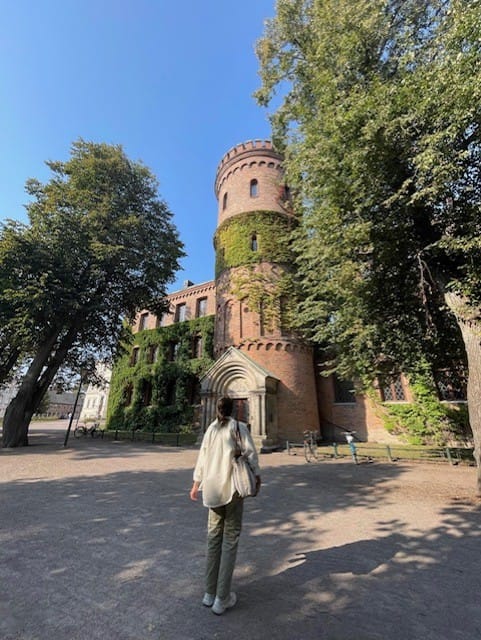
My name is Sanne and this fall I will be doing my internship at Leader Skåne Mitt Nordväst. In this post I want to tell you a little about myself, my education and why rural development is close to my heart.
I grew up outside Halmstad, on the border between city and countryside, – where rapeseed fields and gravel roads meet the pulse of Tylösand and rush hour traffic. My first encounter with rural development was in high school when my geography teacher showed Po Tidholm’s documentary “The Rest of Sweden”, which reflects a rather bleak picture of a changing countryside. But there was something about the people, those who quote “insist on living there”, that stuck with me. It sparked a curiosity about why the conditions differ so much between city and country, and about how people meet, collaborate and try to shape their own future despite it. That curiosity, together with my high school teacher’s inexhaustible knowledge and contagious enthusiasm, made me put my dream of becoming a police officer on the shelf for a degree in geography.
After graduating in geography, I lacked a clear direction and felt the need to delve deeper into a narrower field. I chose Lund and a master's degree in Human Ecology, which, ironically, turned out to be even broader and more difficult to explain...
When I am asked that explain what Human Ecology is, I usually answer that it is fundamentally about the relationship between humans and the environment – from a societal perspective. With influences from a number of different disciplines, Human Ecology invites discussions about how culture, power and sustainability are connected to the social and environmental challenges of our time. When I have come this far in the explanation, I usually have lost the people I try to describe my study choices to. My grandmother has stopped trying to understand and now just shows me a piece of paper with the name of the program on it as soon as someone asks what her grandson does, and my bonus dad usually confuses it with HR (close enough, I guess?).
”"I hope that my time here will give me a more nuanced view of rural development"”
When I heard about I saw Leader as an opportunity to link my education with my interest in rural development. Human ecology and the Leader method share the same idea – to start from the bottom up and to gather different perspectives around the same table. In the classroom, I am trained to communicate across borders, between subjects and cultures, but also between business, politics and social movements. This autumn I look forward to experiencing this in practice: to see how new ideas and solutions emerge when people come together. It feels incredibly exciting to be a small part of Leader Skåne Mitt Nordväst and I hope that my time here will give me a more nuanced view of rural development – one that challenges the gloom Tidholm’s documentary once left behind.